Why Are the Sun and Moon Always Together in Mexican Art
Why Practise Nosotros See the Moon in Daylight?
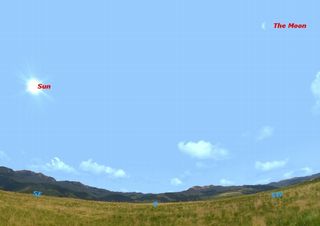
Whatsoever clear forenoon this week around ten a.m. you can see the moon riding loftier in the western heaven. Many people are surprised to see the moon in full daylight, all the same it is a completely normal occurrence.
A very common misconception in astronomy is that the moon is straight contrary the sun in the sky. In fact, the moon is just in this position for a single instant in the whole lunar month: the exact time of full moon, when it is 180 degrees abroad from the sun. The residue of the month information technology can be anywhere from 0 to180 degrees away and, at to the lowest degree in theory, visible in the daytime heaven.
At full moon, the moon is exactly reverse the lord's day. This means that the moon rises only as the sun is setting, and sets just as the dominicus is ascent. This is besides the but nighttime in the calendar month when a lunar eclipse can happen. Withal, eclipses ordinarily happen only one total moon out of every six; the other times the Earth'southward shadow is either too loftier or too low to touch the moon.
2 things contribute to the moon being visible in daylight. Beginning, it is bright enough that its light penetrates the scattered blue low-cal of the sky. If you're looking at exactly the right spot with a telescope, you lot can also see the planets Mercury, Venus, and Jupiter in daylight, plus a few of the brightest stars (though few casual observers tin can actually pull this off). Secondly, the moon must be loftier plenty in the heaven to be visible.
Because of the Globe's rotation, the moon is above the horizon roughly 12 hours out of every 24. Since those 12 hours almost never coincide with the roughly 12 hours of daylight in every 24 hours, the possible window for observing the moon in daylight averages about six hours a solar day.
The moon is visible in daylight nearly every mean solar day, the exceptions being shut to new moon, when the moon is too close to the sun to exist visible, and close to total moon when it is only visible at dark. The best times in the calendar month to see the moon in daylight are close to get-go and concluding quarter, when the moon is 90 degrees abroad from the sun in the heaven.
That's the situation this week. Last quarter is on Sat, Sept. 12. If we prepare Starry Night software to that appointment, and its location to New York, we run into that the moon rises at 11:06 p.m. the dark before. The lord's day rises at 6:34 a.m., at which fourth dimension the moon is 74 degrees above the horizon, near overhead. Sun and moon will both be in a higher place the horizon until the moon sets at 3:03 p.m., although the moon volition exist hard to see for the last hour or so because of horizon haze.
Similarly, the moon will be well placed for daytime observation nigh first quarter, which side by side falls on Sabbatum, Sept. 26. The departure here is that the sun volition be leading the moon, setting at 6:46 p.m., followed by moonset at 12:06 a.m.
One time yous've seen the daylight moon on these "easy" dates, information technology's worth trying to see how many days in the calendar month you tin manage to spot information technology.
- More Night Sky Features from Starry Night Education
This article was provided to SPACE.com by Starry Night Didactics, the leader in infinite scientific discipline curriculum solutions.
Bring together our Space Forums to keep talking space on the latest missions, night sky and more! And if y'all take a news tip, correction or comment, let us know at: community@space.com.
Geoff Gaherty was Space.com'south Night Sky columnist and in partnership with Starry Night software and a defended amateur astronomer who sought to share the wonders of the night sky with the world. Based in Canada, Geoff studied mathematics and physics at McGill University and earned a Ph.D. in anthropology from the Academy of Toronto, all while pursuing a passion for the night sky and serving equally an astronomy communicator. He credited a fractional solar eclipse observed in 1946 (at historic period 5) and his 1957 sighting of the Comet Arend-Roland as a teenager for sparking his interest in apprentice astronomy. In 2008, Geoff won the Chant Medal from the Royal Astronomical Society of Canada, an laurels given to a Canadian amateur astronomer in recognition of their lifetime achievements. Sadly, Geoff passed away July seven, 2016 due to complications from a kidney transplant, but his legacy continues at Starry Night.
Source: https://www.space.com/7267-moon-daylight.html

Enviar um comentário for "Why Are the Sun and Moon Always Together in Mexican Art"